



SMALL GRANTS PROGRAM
19th REQUEST FOR PROPOSALS
Open: August 25th - October 20th, 2026
MAR Fund is delighted to announce its Small Grants Program annual request for proposals (RfP) with two available financial windows:
1. Traditional Small Grants Window:
Supporting Coastal and Marine resources management and protection in the Mesoamerican Reef (MAR).
This window will support: 1) Sustainable ventures/businesses with a demonstrable positive impact on the natural resources of the MAR, 2) Resilience of protected areas, coastal communities, and NGOs, 3) Wastewater and solid waste management and 4) Effective conservation and protection of fish spawning aggregations (FSA). This window is restricted to specific protected areas.
2. Reef Rescue Initiative Window:
Supporting and strengthening science-based restoration, repopulation, and rehabilitation of coral reefs in the MAR region.
This window will promote: 1) Activities that address coral bleaching, 2) Strategies to prevent, monitor and respond to coral diseases including the Stony Coral Tissue Loss Disease (SCTLD), 3) Innovative techniques for coral reef restoration, repopulation, and rehabilitation, and 4) Sustainable ventures or market opportunities that incorporate coral restoration and/or protection. This window is not restricted to specific protected areas.

1. Traditional Small Grants Window
Supporting Coastal and Marine resources management and protection in the Mesoamerican Reef (MAR)
The French Facility for Global Environment (FFEM), the German Cooperation through KfW, the Paul M. Angell Family Foundation and the Mesoamerican Reef Fund (MAR Fund) are pleased to announce the 19th joint request for proposals. Please find below detailed information on the objectives, eligible applicants, proposal template, deadline, and instructions for proposal presentation.
General objective
Contribute to the conservation of the ecosystem functions of the Mesoamerican Reef System and its resilience.
Specific Objectives
- Support the design and/or implementation of sustainable ventures or businesses that demonstrate positive impacts on the natural resources of the MAR, with priority given to market-based innovations addressing untreated wastewater, solid waste management, and women- or indigenous community-led initiatives.
- Strengthen the resilience of protected areas, coastal communities, and local NGOs.
- Advance actions related to wastewater and solid waste management.
- Support efforts that contribute to the effective conservation and protection of fish spawning aggregation (FSA) sites across the region.
Legally recognized/registered women’s, indigenous and community groups are welcome to submit proposals directly.
The following table provides examples of possible eligible investments. However, activities that are not included in the table may be funded. If you have questions about a particular activity, please contact Elisa Blanda (eblanda@marfund.org).
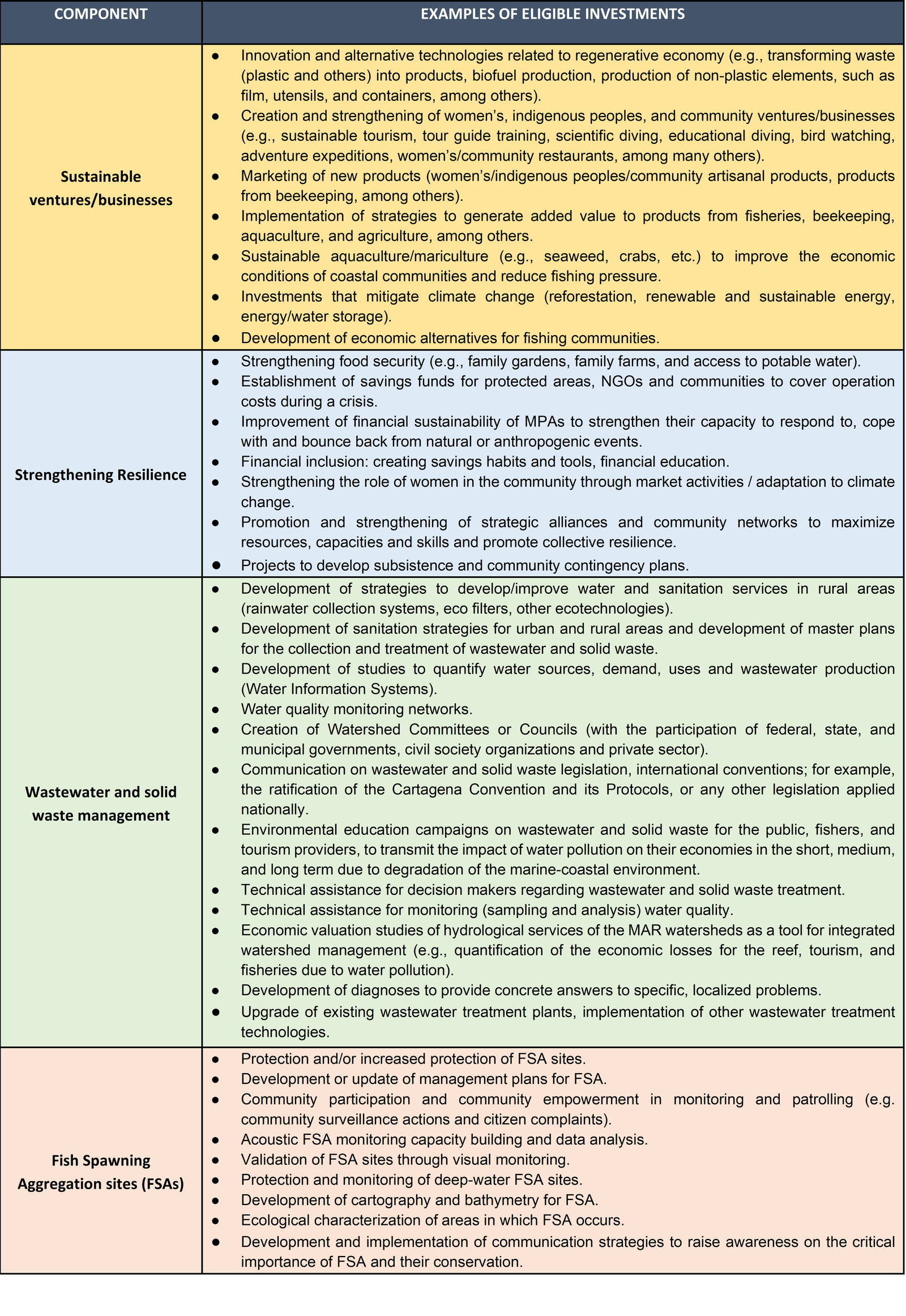
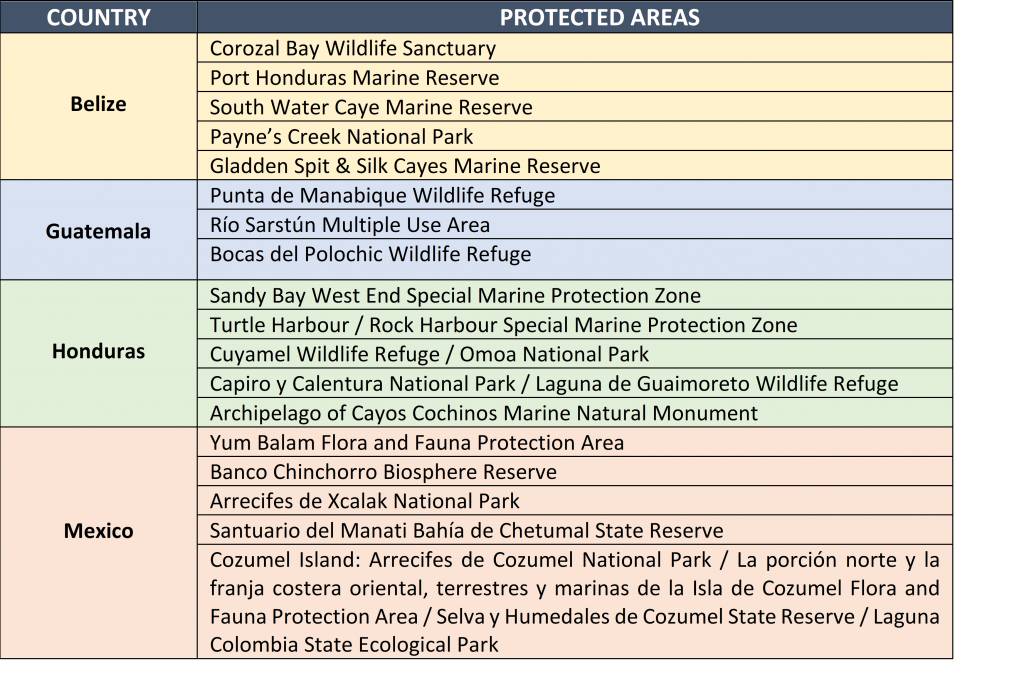
The objectives: A. “Support the design and/or implementation of sustainable ventures/businesses with a demonstrable positive impact on the natural resources of the MAR”, B. “Support actions to strengthen the resilience of protected areas, coastal communities, and NGOs” and C. “Support and strengthen efforts for wastewater and solid waste management”, apply to the following 18 prioritized coastal and marine protected areas, as well as their areas of influence.
The fourth objective, D. “Support activities related to effective conservation and protection of fish spawning aggregation (FSA) sites in the region” is not restricted to protected areas
The proposals to be presented may have a duration of up to two years. Proposals with a duration of up to 17 months may request a maximum amount of US$30,000, while proposals between 18 and 24 months may request a maximum amount of US$50,000, based on project needs and capacity of the implementing institution. For two-year projects, funding is approved for both years, but disbursement for the second year will depend on performance in the first year.
Two-year Projects
For proposals with a duration of 2 years (with a maximum amount of US$50,000), the applicant may allocate between US$8,000 to US$10,000 to subgrants (on-granting). For example, this amount may be used as seed funding for different women’s, indigenous peoples, and/or community projects if on-granting aligns with the objectives of the overall proposal. The methodology to be carried out for selecting and assigning the subgrants and the compliance with environmental and social safeguards must be clearly explained in the proposal.
RfP guidelines for the Traditional Small Grants Window please click here.
2. Reef Rescue Initiative (RRI) Window:
Supporting and strengthening science-based restoration, repopulation and rehabilitation of coral reefs in the MAR region.
The German Cooperation through KfW, the Mesoamerican Reef Fund (MAR Fund) and the Central American Commission for Environment and Development (CCAD) are pleased to announce the celebration of ten years of supporting the Reef Rescue Initiative (RRI) window. This window focuses on coral reefs in the region and is not restricted to specific protected areas.
Objectives
- Develop activities that address coral bleaching, such as monitoring and mapping, identification of bleaching impacts and resilience, mitigation measures, and the design and implementation of coral restoration plans.
- Promote strategies to prevent, monitor and respond to coral diseases, including the Stony Coral Tissue Loss Disease (SCTLD).
- Support the development and application of innovative techniques for coral restoration, repopulation, and rehabilitation in areas actively addressing reef-related threats.
- Support for sustainable ventures or emerging market opportunities that incorporate coral restoration and/or protection.
The following table provides examples of possible eligible activities. However, activities that are not included in the table may be funded. If you have questions about a particular activity, please contact Elisa Blanda (eblanda@marfund.org).
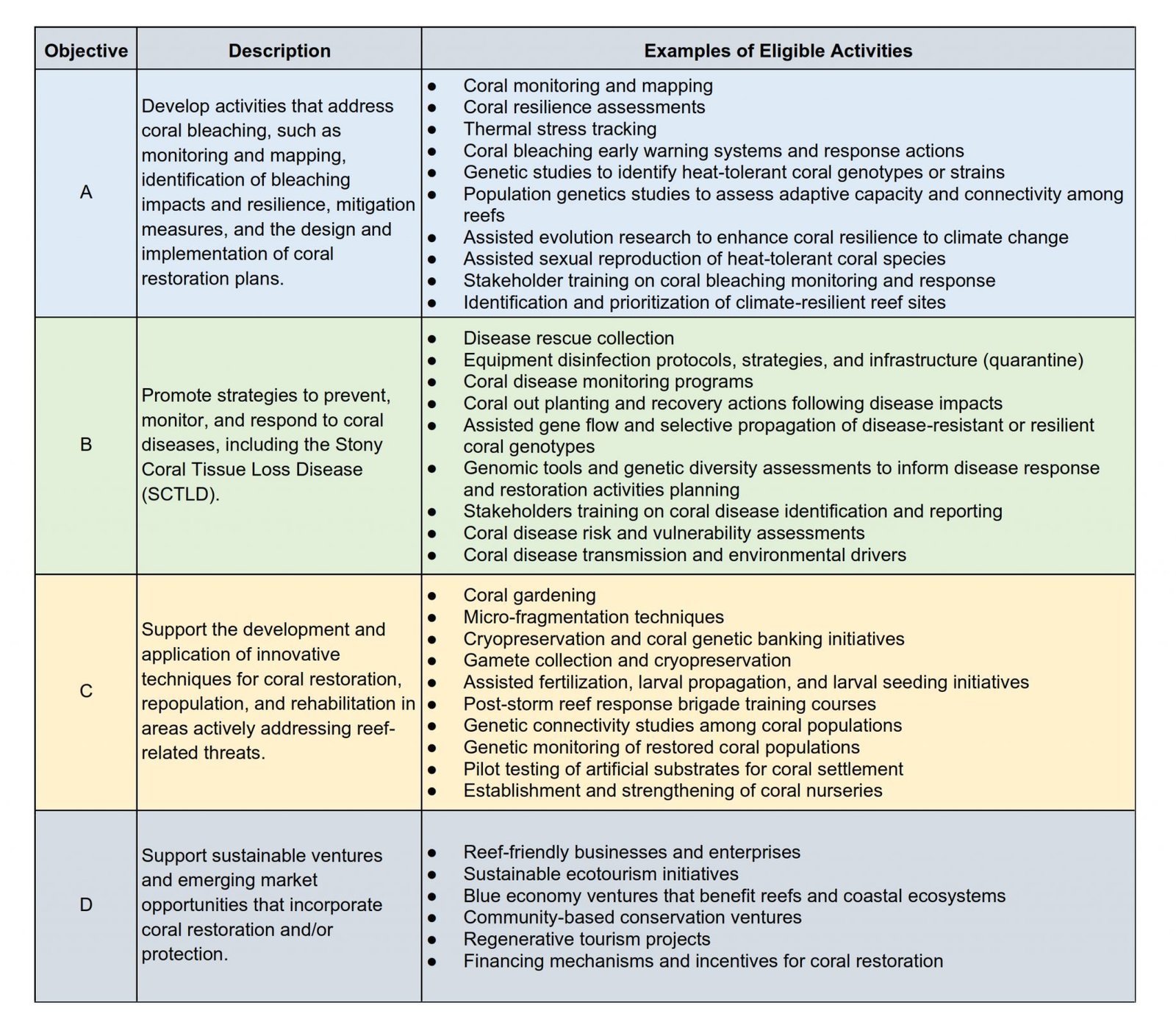
This window is not restricted to protected areas. All coral reefs within the MAR region are eligible. Proposals must clearly justify the site where activities will take place for the benefit of the MAR system.
The proposals to be presented may have a duration of up to 24 months. The maximum grant amount is US$33,000, based on project needs and capacity of the implementing institution.
RfP guidelines for the Reef Rescue Initiative Window please click here.
RfP guidelines for the
Traditional and the Reef Rescue Initiative windows:
The following list includes eligible applicants for this request for proposals:
- Community-based organizations, including women’s and indigenous people’s organizations,
- Non-governmental organizations,
- Governmental institutions, academic institutions, and individuals (who must have administrative support from an NGO to submit the proposal and be responsible for the grant if the project is approved).
Potential grantee organizations must:
- Be duly registered or legally recognized in one of the four countries of the Mesoamerican Reef (MAR) region (Mexico, Belize, Guatemala, and Honduras);
- Be in compliance and good standing with all requirements for operation as a legal local entity;
- Be guided by an operational Board of Directors;
- Have a sound financial management system and structure in place (accounting, annual audits, etc.);
- Have a good history as a grantee (i.e., effective grant/project implementation); and
- Have experience in the field of coastal and marine resources management.
Community organizations –including women’s and indigenous people’s organizations– may be supported directly or indirectly through an NGO, as long as a signed agreement exists and is shared between the two that demonstrates that the community organization is an active co-designer and participant in the project.
To maximize available resources, proposals involving duplication of funds/efforts funded by other MAR Fund initiatives or programs will not be considered.
Eligible applicants may submit a maximum of two proposals per RfP.
All supported organizations must implement and monitor the compliance of MAR Fund’s Environmental and Social Management System (ESMS) throughout project execution. If the organization already has its own policies or procedures, these may be applied if they fulfill the requirements of the MAR Fund ESMS.
In addition to finding the information related to the ESMS on our website, revision of Appendix B is recommended. It includes other requirements to apply to this RfP. For questions about the ESMS, please contact the following people: Elisa Blanda (eblanda@marfund.org) and Karla Zaldaña (kzaldana@marfund.org).
The following criteria will be applied in the revision and selection of proposals. Some projects may not necessarily comply with all the conditions. Projects should:
- Demonstrate measurable results on the progress of at least one of the stated RfP objectives;
- Be implemented within the MAR region;
- Coordinate their implementation across multiple stakeholders;
- Have transferable or replicable outcomes for other communities/protected areas;
- Strengthen local management capacity of professionals and institutions for the protection and management of coastal and marine resources of the MAR;
- Contribute to strengthening local capacities;
- Engage the MPAs of interest, and be aligned with their management plans and with the institutional priorities of the protected area managers;
- Create a new source of financing to reduce the financial gap of the protected area in which you will work (if applicable);
- Align with national, regional or global strategies, plans or policies;
- Align with ridge-to-reef strategies;
- Have activities that are closely aligned with the applicant organization’s mission;
- Propose activities that are sustainable beyond the project period;
- Build on current work in the area or successful model projects in the region;
- Demonstrate community participation and empowerment in the proposed activities (community/NGO/GO endorsement letters as backup documents);
- For collaborations with other local entities (women’s, indigenous peoples, and community groups/organizations, NGO and GO), please provide collaboration letters for the project;
- Promote collective and/or community resilience; and
- Clearly identify and assess the environmental and social risks and impacts of the proposed activities.
Specific criteria for the Reef Rescue Initiative window:
- Create a new source of funding for coral reef restoration in the region (if applicable); and
- Generate transferable results to sites with potential for coral reef restoration.
For this RfP, at least 25% of the total budget must come from other sources, as a match to the requested funds. The match may be both cash and in-kind. Salaries/partial salaries of people directly involved in the development of the project may be included. The maximum amount allowed for administration expenses cannot exceed 10% of the total amount requested. Administration expenses (overhead) refer exclusively to the fixed operating costs of the organization.
The costs of implementing and complying with the Environmental and Social Management System (ESMS) may be included in the budget. Eligible costs are, for example, the purchase of health & safety equipment, first aid kits, and diving insurance, among others, to be detailed in the proposal budget. Information related to the ESMS can be found on our website.
If your proposal is the continuation of a project supported by the small grants program and that ended a maximum of 3 months ago or is about to end (in a maximum of 6 months), you may submit a new proposal by selecting the “CONTINUITY” option in the online proposal form/template. Proponents may use the information from the previous proposal or adjust the information as needed. Please include a brief update on the results to date in the Introduction and Justification section (bullet c, online proposal form/template). You should also attach the due diligence documents that have been modified/updated, the new Project Development Table, the Project Budget, and the Environmental and Social Screening Tool.
This proposal will undergo evaluation like the others. If the proposal is approved, a modification to the last grant agreement will be made to expedite the donation process.
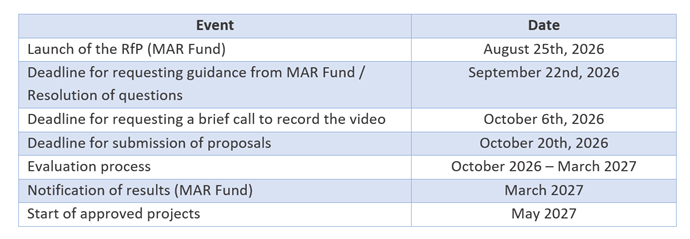
MAR Fund can answer questions in relation to the project idea, coherence and structure of the proposal and elements included in the documents or annexes. For this, the proponents must contact MAR Fund central office with ample time (no later than four weeks after the launch of the RfP, by September 22nd, 2026) to be attended. The guidance provided does not imply approval of the proposal; final approval of proposals is the exclusive responsibility of the Board of Directors.
In addition to the proposal, a video of maximum three minutes may be submitted, in which the implementers, the objective, the activities, the expected results, the proposed impacts of the project and any relevant context information not mentioned in the proposal are presented in a summarized and engaging way. This does not have to be a professional video, but rather an informal –but informative– one prepared by the proponents (e.g. with mobile phones). Alternatively, the proponent may request a brief call with Elisa Blanda (eblanda@marfund.org) and Karla Zaldaña (kzaldana@marfund.org), at least two weeks before the deadline, by October 6th, 2026, to present in no more than three minutes the same information that is required for the video. This call will be recorded and shared with the evaluation committee.
Complete proposals and the due diligence documentation, including the signed Appendix B, must be submitted through the on-line form/template on the MAR Fund webpage. Applicants submitting a proposal on the implementation of sustainable ventures/businesses that can demonstrate a positive impact on the natural resources of the MAR must also fill out the business form. Proposals that do not present complete documentation will not be evaluated and will be discarded.
Attached you will find the proposal template and annexes in Word/Excel. For community organizations or groups that can demonstrate the unavailability of an Internet connection, proposals can be sent to the following addresses of the MAR Fund central office or founding member, depending on the country in which the proposal will be submitted:
FOR MEXICO, GUATEMALA, HONDURAS
The Mesoamerican Reef Fund (MAR Fund)
c/o Elisa Blanda
22 Av. 0-59, Zona 15, Vista Hermosa II, Guatemala, Guatemala 01015
Email address: eblanda@marfund.org
FOR BELIZE
Protected Areas Conservation Trust (PACT)
c/o Robbin Burns
2 Mango Street, Belmopan City, Cayo, Belize
Email address: cimanager@pactbelize.org
The deadline for the submission of proposals is October 20th, 2026. All proposals must be received no later than 11:59 p. m. in each country on that date. If technical assistance is required, it will be provided until the same day at 5:00 p. m. (CST).
Proposals may be submitted in English or Spanish.
- Applicants and grantees must comply with the MAR Funds ESMS during proposal application and project implementation.
- If the proposal includes construction of small infrastructure, the applicant must submit documented proof of land ownership or legal right to use the land at the proposal stage. Acceptable documentation may include, as applicable: registered property titles, purchase agreements, loan-for-use (comodato) contracts, assembly resolutions for communal or ejido lands (communal lands), approved management plan or program (for co-managers or managers), or any other legally valid documents in accordance with national regulations.
- If the proposal is approved, the grantee must comply with all applicable national laws and administrative regulations for the receipt and management of donation funds, including legal registration, tax obligations, financial reporting, and banking compliance. The organization shall maintain proper accounting records, ensure traceability of funds, and make such records available for audit upon request.
- If the proposal is approved, beneficiaries are responsible for providing a bank account in the name of the NGO to receive the funds, along with all necessary and accurate details required for international transfers. Beneficiaries must also notify their bank of the incoming funds and provide any information needed to ensure successful receipt from abroad.
The selection process will be carried out in accordance with MAR Fund’s internal evaluation guidelines, and the result will be final. Applicants whose proposals are incomplete or do not meet the RfP guidelines will be notified early in the process. Those selected to advance to the next stage will be contacted with instructions to make necessary revisions if required. Proposals submitted under the RRI window will also be reviewed by the RRI Technical Supervisory Committee (TSC), which will provide technical recommendations. Project proposals will then be reviewed by the SGP Grants and Evaluation Committee, which will recommend the proposals to be supported in this RfP to be sent to the MAR Fund Board of Directors, who will make the final decision.
Applicants will be notified of the selection process results in March 2027, through the online platform and by email.
For questions on this request for proposals and the grant process, please contact the following person:
Elisa Blanda
Small Grants Program Officer
Central Office
eblanda@marfund.org
- Proponents, including those participating in the proposal preparation workshops prior to the launch of this Request for Proposals, are responsible for all costs associated with preparing and submitting their proposals to MAR Fund. MAR Fund is under no obligation to reimburse these costs – either in whole or in part – or to provide any advance payments or compensation if their proposal(s) is not selected. The guidance provided during the workshops does not imply approval of the proposal; final approval of proposals is the exclusive responsibility of the Board of Directors.
- Proponents acknowledge and accept that the preparation of the proposal(s) does not constitute a financial obligation on behalf of MAR Fund, and therefore the economic and financial responsibility for the preparation of the proposal(s) is exclusive of the proponent(s), regardless of the selection process outcome.
- Organizations selected for funding will be expected to implement the project in accordance with the approved proposal, budget, and work plan, maintain sound financial management, comply with MAR Fund procurement requirements, and submit all required technical, financial, and environmental and social reports on time, according to the grant agreement. Grantees will also be required to acknowledge MAR Fund support in project communications and share project results, products, datasets, maps, photographs, videos, and other deliverables generated through the grant.
- During project implementation and/or after project completion, grantees may also be requested to participate in monitoring, evaluations, field visits, audits, and other verification processes related to the grant, performed by MAR Fund staff, donors or advisory committees.
Download the proposal format and annexes
Proposals must be submitted (except in particular cases) through the MAR Fund on-line Small Grants Program system.
As a first step, revise if your organization is already registered in our system by consulting the list below:
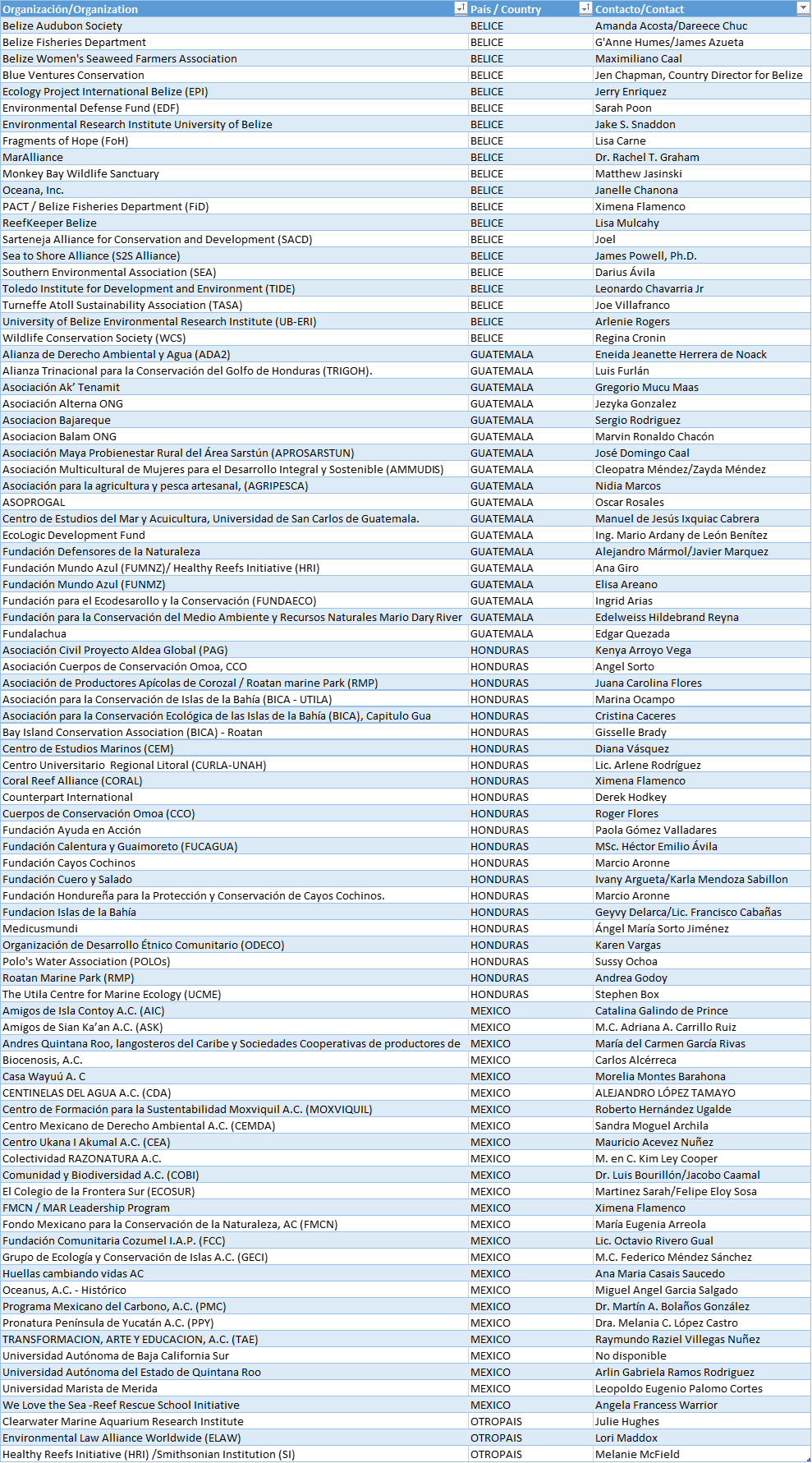
If your organization is already registered, you can go directly to the project management system (https://ppd-sgp.marfund.org/) and add a new project.
In the event that your organization is already registered and you do not know or remember the access credential, please contact Elisa Blanda (eblanda@marfund.org) for technical support.
If your organization is not in the list above, please register at the following link https://ppd-sgp.marfund.org/forms/en, completing the organization form.
We recommend registering as soon as possible. Upon registration, you will receive a notification email with your on-line access credentials.
Partners of the two financial windows
German Development Bank (KfW)
The KfW is the German Development Bank based in Frankfurt. Its name originally comes from “Reconstruction Credit Institute”. It was established in 1948 after World War II as part of the Marshall Plan. The purpose of the institution is to support the economy, society and ecology worldwide. It supports the sustainable improvement of economic and living conditions of the middle-class population, protection of natural resources, housing economy, infrastructure, education, financing of projects and exports and development cooperation. As of 2018, it is Germany’s third largest bank by balance sheet. It covers over 90% of its borrowing needs in the capital markets, mainly through bonds that are guaranteed by the federal government. This allows KfW to raise funds at advantageous conditions. Its exemption from having to pay corporate taxes due to its legal status as a public agency and unremunerated equity provided by its public shareholders allow KfW to provide loans for purposes prescribed by the KfW law at lower rates than commercial banks. KfW has been involved in the conservation of the Mesoamerican Reef (MAR), supporting the strengthening of coastal and marine protected areas, protecting natural resources, and promoting their sustainable use.
French Facility for Global Environment (FFEM)
The French Facility for Global Environment (FFEM) was established to promote a sustainable global environment and works across Latin America, Africa and Asia in the protection of ecosystems. Their work primarily involves dealing with climate change and protecting the ozone layer, biodiversity, marine protection, and soil degradation. FFEM has worked in various national parks in these continents together with other global environmental groups such as the World Wide Fund for Nature, funding the protection of areas of ecological vulnerability. It has also done much work in the Indian Ocean islands such as the Seychelles. In the Mesoamerican Reef (MAR), FFEM also supports the recovery of fish populations by strengthening the protection and monitoring of a regional network of fish spawning aggregation sites.
Paul M. Angell Family Foundation
In 1996, David and Lynn Angell created a family foundation to administer their philanthropic efforts. For them, philanthropy was an extension of their natural inclination to help people, knowing that sometimes people need a hand. Helping others was a principle they took seriously and enjoyed immensely, and their motivations sprang from a deep, spiritual desire to make a difference in the world. The Foundation promotes high-impact programs that help people achieve self-sufficiency and well-being by providing them with basic necessities and economic stability. The Foundation has been involved in the conservation of the Mesoamerican Reef (MAR), addressing one of the main threats to the region: untreated wastewater effluents and solid waste, supporting the construction and/or improvement of infrastructure for the management of solid and liquid waste, changing the behavior of communities through education, the implementation of good environmental practices and the creation of new alliances for the protection of water resources, among others.
Central American Commission for Environment and Development (CCAD)
The Central American Commission for Environment and Development (CCAD) is the organ of the Central American Integration System (SICA) responsible for the environmental agenda. Its objective is “to contribute to the sustainable development of the Central American region, strengthening the cooperation and integration regime for environmental management”. The CCAD seeks the appropriate way to make national policy and legislation guidelines compatible with regional strategies for the conservation and restoration of coral reefs, in order to establish collaboration among the countries of the region to jointly seek the adoption of sustainable development practices, promoting projects with a ridge-to-reef vision.
Mesoamerican Reef Fund
The Mesoamerican Reef Fund (MAR Fund) is a private regional environmental fund established to support conservation and sustainable use of natural resources in the Mesoamerican Reef (MAR) as a single ecosystem and ecoregion. Its mission is to seek, secure and facilitate regional funding, foster partnerships and drive capacity building for the conservation, restoration, and sustainable use of marine and coastal ecosystems in the Mesoamerican Reef region. It was established by four pre-existing environmental funds, one from each MAR country: Protected Areas Conservation Trust (PACT) in Belize, Fundación para la Conservación de los Recursos Naturales y Ambiente en Guatemala (FCG) in Guatemala, Fundación Biosfera (FB) in Honduras, and Fondo Mexicano para la Conservación de la Naturaleza (FMCN) in Mexico. (www.marfund.org).